|
||
|
|
|
|
|
|
||
Legal Issues
|
|
|
|
|
|
Copyright © 2002-2017 John Mayer. All rights reserved. For reuse policy see Reuse Policy In this section:
This section contains information on registering your HDT, licensing
issues, a discussion of towing doubles (towing a vehicle behind your
5er), and issues with driving your HDT home after your purchase. We get the registration question a lot. Here is what we did - it is
based on Texas registration, and doing this registration in Livingston
where they are familiar with strange RV stuff; however, every state is
different. We chose to title the tractor as a motor home. You can do this in TX if you show that the tractor is self-contained. Search on the Texas DMV site for form VTR-61. The Texas Title Manual contains the following:
The advantage of titling as a motor home is that you are exempt from all
CDL requirements (which you can escape other ways, as well), and that in
other states, you will be exempt from running through the scales. Some
states require any truck over 8,000 lbs (or other weights) to cross the
scales EVEN if you are not commercial. This is the major advantage of
motor home vs. truck in Texas. Your insurance may be lower as well, but I
have no data to support that. Here is the process.
The entire process - taking the pictures, getting them developed at
Wal-Mart, scaling the truck, inspection, and registration took me less
than 2 hours in Livingston. One registration option when buying an HDT (or an RV or other auto)
is to establish a Limited Liability Corporation (LLC) in Montana,
transfer title of the vehicles to the LLC and register the vehicles
through it. This will allow you to escape all sales taxes on the
vehicles, and also potentially provides you some liability protection. It is a
perfectly legal method to avoid taxes. You may maintain residence in
your state of choice, however, there are some limitations to this.
In any case, if you intend to
set up an LLC you need experienced legal advice. Each state and
individual situation is different, so do not depend on this website, or
any online resource for legal advice. An LLC seems best suited to full time RVers, since each state has
limitations on how long an out of state vehicle can remain in-state
before having to be re-registered in your state of residence. In the
case of Texas (a popular residence for full timers) it is 30 days. If
you inquire about setting up an LLC in Montana, the law firm you contact
will forward you the laws covering your state of residence and advise
you if it is practical to use an LLC to avoid taxes in your state of
residence. Some additional advantages to the Montana LLC route: • The trailer can have lifetime registration. A typical LLC setup costs about $1282.50 at the time this was written. $850 Setup cost for Bennett Law BENNETT LAW OFFICE P.C. John M. Bennett Thaddeus J. Brinkman Alain B. Burrese I got the following commentary from an attorney about LLC's. He brings up some interesting points: The first issue I would address is raised by many when the issue of a foreign (meaning out-of-state) LLCs owning RVs to avoid in-state sales tax is raised. There are those who condemn this practice as they somehow think tax avoidance is illegal, immoral, or worse. There is a difference between tax avoidance and tax evasion. To quote Denis Healey, "The difference between tax avoidance and tax evasion is the thickness of a prison wall." Simply put, tax evasion is taking action or failing to take action in violation of the tax laws. Try tax evasion and the iron motel might be in your future. Another quote from Justice Learned Hand, "Over and over again courts have said that there is nothing sinister in so arranging one's affairs as to keep taxes as low as possible. Everybody does so, rich or poor; and all do right, for nobody owes any public duty to pay more than the law demands: taxes are enforced exactions, not voluntary contributions." Arranging your affairs to minimize taxes is tax avoidance as long as all laws are followed. And finally, Justice Hand again, "In America there are two tax systems, one for the informed and one for the uninformed. Both systems are legal." States that have a state sales tax absolutely hate it when a resident employs a perfectly legal means of avoiding the tax. As a result many are passing or have passed laws to prevent residents from avoiding this tax. Some states have laws that say if a resident owns a foreign LLC that in turn owns personal property, the state ignores the foreign LLC for the purpose the ownership and considers the resident as the actual owner. In the case of an RV, this requires in-state registration and sales tax. Other states have passed laws that say if the resident has the right to use the RV for more than some time period such as 30 days out of the year, the RV must be registered in the state along with the payment of sales tax. In both of these examples, if the state has a personal property tax, that must be paid as well. The net result is that in states that have these laws, creating a foreign LLC does not avoid any tax and adds the costs associated with the LLC. This problem is somewhat reduced if the LLC is set up by full-timers as they can pick the state in which they are residents and they can pick a state that does not try to find a way to collect these taxes. Of course, for residents of Montana there is no problem but there is little need for an LLC in this case. Providing liability protection is often cited as a second reason for having your RV owned by an LLC. The theory is that if your RV is involved in an accident and a lawsuit ensues, only the assets owned by the LLC are subject to forfeiture. This purported benefit is more an illusion than reality. First of all, if you are driving your RV and you are involved in an accident that gets you sued, in all likelihood both the LLC as the owner and you as the individual operator are going to be sued. That means that your assets and the LLC's assets are at risk. Furthermore, for an LLC to be treated as a separate entity by the legal system, the owners must treat it as a separate entity. That means that the LLC would need to have its own bank account and pay its own bills. It could rent the RV to you and the rent monies could be used to pay things like insurance, fuel, and maintenance. How many who set up LLCs do anything like that? As states are constantly seeking means to increase tax revenues, what you learn today about how your state of residency treats foreign LLCs might be different tomorrow. You can't just learn the law today and assume that you are good to go for all time. The law can change, you can go merrily on your way only to discover that you have become a tax evader. Another problem that might be encountered with a foreign LLC is that you can have problems if you are stopped by a law enforcement officer (LEO) and your driver's license state differs from the state of vehicle registration. There is nothing illegal about this but some LEOs don't understand it. You might have to prove that you have the right to be driving the RV, which is not in your name and registered in a state in which you are not a resident. One last problem is that financing and insuring an RV owned by an LLC is a little more complicated than if you owned the RV in your name.
In order to be legal to drive your HDT (or motor home, or
pickup/trailer combo) you may need to upgrade the
class of license you hold. It varies wildly by state, but is usually
based on the GVWR of the vehicle, or the combination of vehicles when
towing. Some states, such as Washington, don’t require any upgrade of
your license, as long as the truck is for personal use. Washington is
also an example of a state that does not have an “upgraded” license
class. You either have a “regular” license, that entitles you to drive
any weight private vehicle, or you have a CDL. You can find a summary of
licensing laws on the
Changing Gears website. Many states have upgraded classes of license, based on the GVWR. I’ll use Texas as an example. In Texas, if the GVWR of the vehicle exceeds 26,000 lbs, or if the GVWR of the vehicle and the trailer together exceed 26,000 lbs (if the trailer is over 10,000 GVWR) then you need a Class A non-CDL license - otherwise known as a Class A "Exempt" license. This is basically a Class A CDL without the parts pertaining to paperwork (such as logbooks and in-service times). This is true even if the HDT is registered as a motor home. Note that even a large pickup, like an F450 may require this upgraded license, if used with a heavy trailer. It is based on the GVWR, NOT the actual scaled weights. For Texas, the test is pretty simple. Study Chapter 14 of the CDL licensing handbook. You then take a written test - you must get 14 of the 20 questions correct. After that you have to take a road test with your truck and trailer. In many locations this may take up to two to three weeks to schedule. The road test in Livingston is pretty simple - there are several tight turns, but it is basically driving around town. In some locations you have to parallel park the trailer - yes, you read that right. But in Livingston the most that you ever have to do is back in a straight line. In Texas if you drive a motor home over 26,000 GVWR then you need a
Class B Exempt license. If you tow a trailer with that motor home that
is over 10,000 lbs GVWR then you need a Class A instead of the Class B. Some states (only a few) require a true CDL to drive an HDT. Some states, but not all, require an air brake endorsement to your
license to drive a vehicle equipped with air brakes. Texas does not
require an air brake endorsement for an RV. Even if your state does not require an upgraded license for your
situation, if it offers one you should study for it and move up to it.
Often this will be the case if you title your HDT as a motor home. Many
states do not require an upgraded license to drive a motor home. So as
long as you are not towing a heavy trailer (10,000 lbs in TX, 15,000 lbs
in CA; other states may vary) you will be legal to drive your
"motor home" without an upgraded license. However, as soon as you hook up
the heavy trailer you need the class A. The information in the tests is
important to know and study if you are driving a large truck. My advice
would be to upgrade your license if your state offers that opportunity. There is also the issue of being stopped in another state and the
officer not recognizing your license as being valid. This is especially
true if you live in one of the few states that allow you to legally
drive the HDT with a class C (or passenger vehicle) license. You do not
want to be in the situation of having to fight a citation like this. If
you do decide to drive your HDT with a “normal” license in other states
then I would carry a copy of the appropriate state vehicle code with
you. You don’t want to get a ticket for an "out of class" license. Bear
in mind that licensing and registration is reciprical between the states
- so if you are legal in your state of domicile you can drive legally
anywhere. If you want a good RV driving school, that can also teach you to
properly drive your truck, check with the RV Driving School. They come highly
recommended, and it is one-on-one instruction. http://www.rvschool.com/ For copies of Texas drivers manuals and CDL study guide, download them from http://www.txdps.state.tx.us/ . For a Class A or B exempt license study the CDL guide and especially the rules and regulations in Chapter 14. You have to know the lighting positions on the truck and you have to know about combination trailers (Chapters 5,6,7) . So be sure to look at those sections. Other than that, the test is pretty simple - use the study guide questions to test yourself. The driving test is pretty simple - but you WILL have to take a new driving test. In some locations they do make you parallel park the RV. In Livingston they usually do not, but in all locations you will need to be able to back up 100' in a straight line. The rest of the test is just common driving. Make sure you signal properly, especially leaving the station, where you will likely be parked roadside. If you have an air brake vehicle you should know how to do an air brake test - although they typically do not ask you to do one. But you need to know how, anyway. So practice it.
I hear it all the time - "I don't want to register in TX because they have state inspection, and I don't want to have to go back every year for inspection - it is too much trouble." You do NOT have to go back to Texas every year for inspection. When you do go back, you have three days from arriving at your in-state "destination" to get inspection done. If you stay out of state you can drive with expired inspection stickers. Police from other states do not care - and have no authority - to enforce TX state inspection rules. It is simply not an issue. In 2015 Texas started combining the inspection with registration renewal. You have to show that you have a current inspection BEFORE they will issue your new registration. However, if you are out of state you can still "self certify" that fact, and not be forced to come back to Texas. Use the online registration website and there is a section during registration to self certify your "out of state" status. Really, the inspection process is not an issue at all. The information below is from the Texas Department of Public Safety website (Inspection Questions)
Once you buy the truck you need to drive it home. Since the truck is
typically registered as a commercial semi-truck the best possible
situation is that you have a CDL. The truck remains a commercial truck
until you re-register it as a private vehicle. If you can, and your
state allows it, register the truck and obtain plates for it before you
go to pick it up. Generally, if you have the VIN and a Bill of Sale you
can do this. If you can not get it registered to your home state before
you get it, make sure that you get a temporary tag from the originating
state (dealer/seller) that allows you to transport the truck. These are
generally 30 day temp tags, but they may be shorter duration. If you
have temp tags on, then you almost always have to go through the scales.
I would not bypass them if I had temp tags. If red-lighted, present your
papers and explain what you are doing. Do not offer your license unless
required, but do offer insurance papers and bill of sale. The scale
personnel are used to dealing with commercial vehicles. If they see a
non-CDL they are VERY likely to shut you down. You will then be in the
position of trying to get them to change their mind by convincing them
you are non-commercial. You don’t want to be in that position. If you are buying from a private party that currently has valid
plates on the truck, see if you can drive home on those plates. Make
sure you get a letter from the owner of the plates giving you permission
to drive the truck. This may keep you from being stopped (since you have
good plates on it). Make sure you have a valid license of the proper class for your
state. If your state allows driving a +26,000 lb vehicle on a “normal”
license, then I would carry that statute with me. If your state allows
for an upgraded license then I would try real hard to get that before
buying the truck. I drove my truck from Kansas City to Livingston, TX on the seller’s plates. All glad-hands were removed and the valves plugged, so if it became an issue I could point out I could not haul a semi-trailer (a weak argument, but an indication of intent). I had “Private RV Not for Hire” signs on the truck. I bypassed the few scales that were open and did not have an issue. If chased down I would have played dumb and hoped for the best. Probably not the best strategy. In the future, I will pre-register any truck I buy and put my own plates on. I will have “Private RV Not for Hire” signs on the truck. If you have a properly registered truck (in your name) then you should not have any problems. Personally, I bypass scales and have never been stopped. But that is a personal choice.
We do double tow, although I have to admit it makes me nervous. I am much more relaxed when towing just the trailer. If building an HDT from scratch, I would seriously consider piggybacking a vehicle. You can configure an HDT to carry just about anything, but if you are just looking for a runabout then a Smart car cross loaded is ideal.
With an HDT and reasonable size 5th wheel you are most likely going to be over length in the majority of states. Our short wheelbase (182”) truck with our 38’ 5th wheel is almost 60’ when combined. Adding a car and tow hitch easily pushes that to an additional 15’, depending on the vehicle. In our case we are 74' 10". Most states have lengths restricted to 70’ to 75’, putting our combination over in many situations. Some argue that if your “home” state allows the length that you are towing then all the states you pass through need to honor that under state reciprocity. That is not true. Each state can enforce its own length restrictions, as well as double towing laws. You can try that argument alongside the road, but I doubt you will get far. Be prepared to unhook. Again, there is NO reciprocity between states on towing doubles, or on length laws! Another consideration in towing double, knowing you may be over length in a certain situation, is liability. What would happen if you were involved in an accident? Would your liability increase because you were “illegal”? Would your insurance carrier deny a claim because you are "illegal"? It is something worth considering in deciding if you want to double tow. There are many people – probably thousands – who have double towed all across the country for years without a problem. From a technology perspective, double towing with an HDT is safe if your equipment is properly set up. You need to educate yourself on the state towing laws, and watch out for those states that strictly enforce double towing laws. So what do you need to do if you want to double tow? Here is what I would recommend. These are strictly my opinions - take them for what they are worth.
Driving doubles is not
really much different than normal towing. The car will track within the
trailer tracks, so corners are not really an issue. Of course, there is no
chance of backing up, so you better be sure of your clearances when
turning. You do have to allow additional stopping space, so I would
increase my following distances. Normally, I allow a four - six second
interval between me and the vehicle in front. A 50% increase to 6-8
seconds, where possible, is a good idea. Here is what I do, for what it is worth:
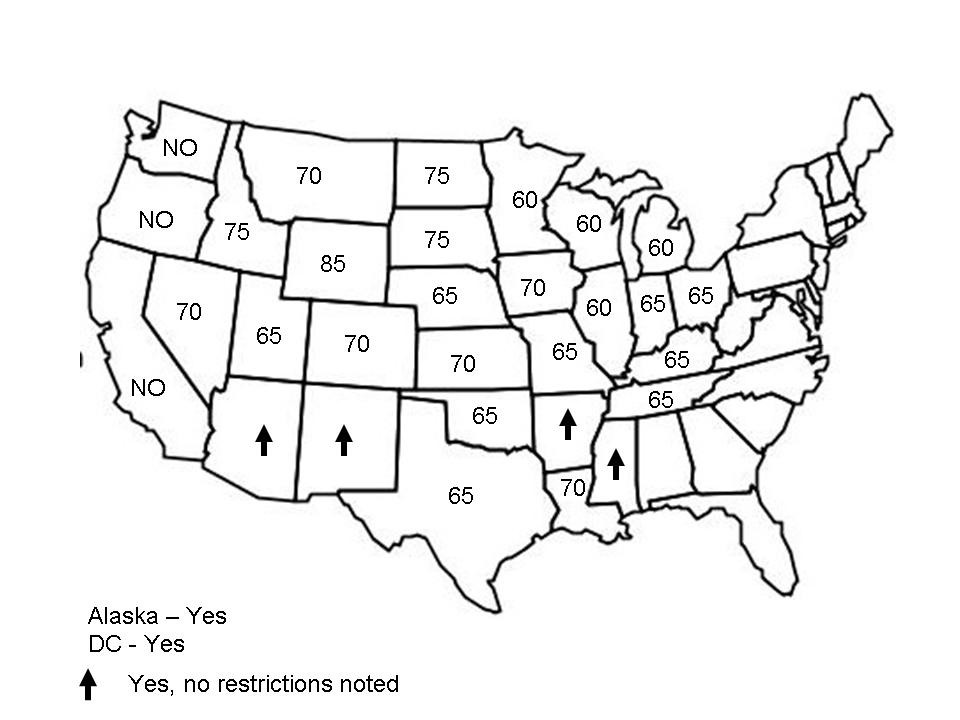
The equipment we are using is: Blue Ox Aventa II tow bar (10K lbs rating), SMI Air Force One air-based brake system (this is a "live pedal" system), a color camera on the 5er to monitor the Jeep, and some additional tire monitors on the Jeep (with an external antenna on the truck). On the Royals International that we started towing doubles with, we reinforced the trailer hitch with heavy steel plate - it is definitely not coming off! On the trailer we own now - the New Horizons that we had custom built - we had the hitch area "overbuilt" at the factory. A note about the brake system. We originally used the Blue Ox Toad Stop II system, and I DO NOT recommend it. It never worked to my satisfaction on my Jeep, although it does work well on a friends Acura. The more popular, and in my opinion better, brake systems for use with an HDT are the SMI Air Force One, and the M&G system. Both use the service brake air supply to drive the toad brake system, and are permanent live pedal systems. Both have a track record in use on HDT's towing doubles. We upgraded to the SMI Air Force One when we purchased the New Horizons. The Air Force One is easier to install and works well. Both require service brake air to be fed to the toad. The map below shows the states that allow towing of doubles. If the state has a number in it, it allows doubles, and the number indicates the overall length. States with "NO" in them, or states with no numbers in them do not allow towing of doubles. In addition, British Columbia does not allow towing doubles of any type, so if you are using that route to Alaska you need to be aware of that. Click on the map to expand it.
|
|
|
|
||
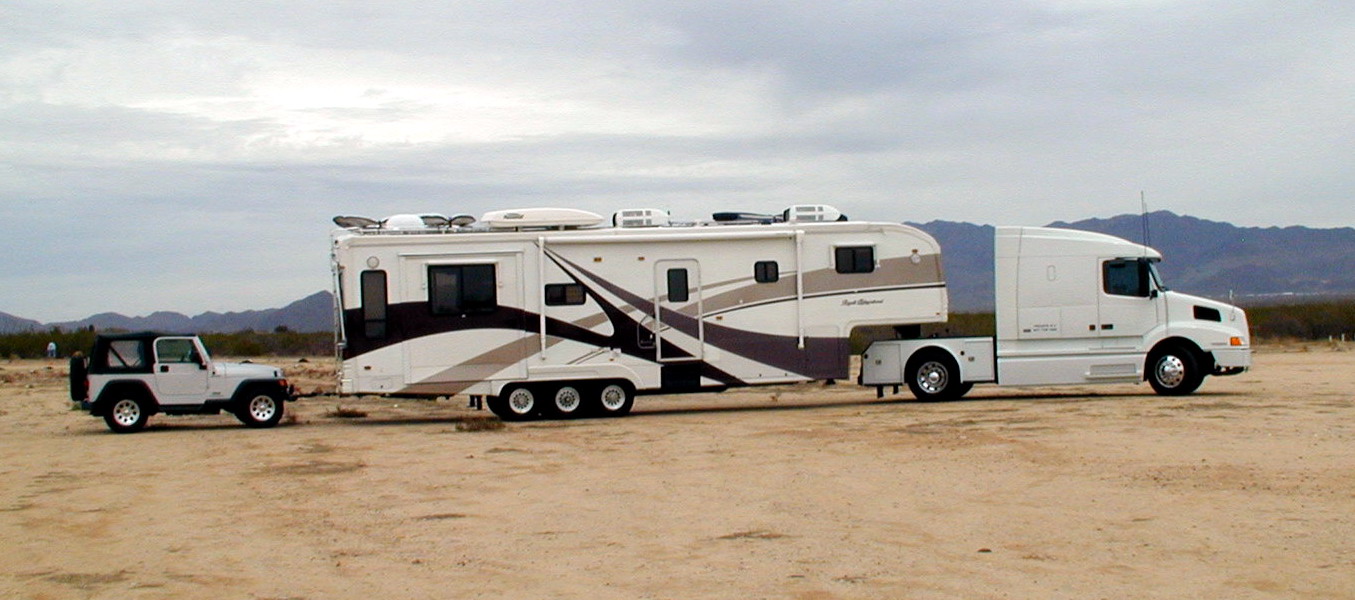 Towing doubles (sometimes,
incorrectly, called triple towing) involves towing a car or boat behind your 5th
wheel. It is legal in many states, and many people do it. With a MDT or
HDT you are probably towing with as safe a tow vehicle as you could
have. An HDT certainly has enough power, brakes and stability to handle
a double towing situation, where it is legal.
Towing doubles (sometimes,
incorrectly, called triple towing) involves towing a car or boat behind your 5th
wheel. It is legal in many states, and many people do it. With a MDT or
HDT you are probably towing with as safe a tow vehicle as you could
have. An HDT certainly has enough power, brakes and stability to handle
a double towing situation, where it is legal. 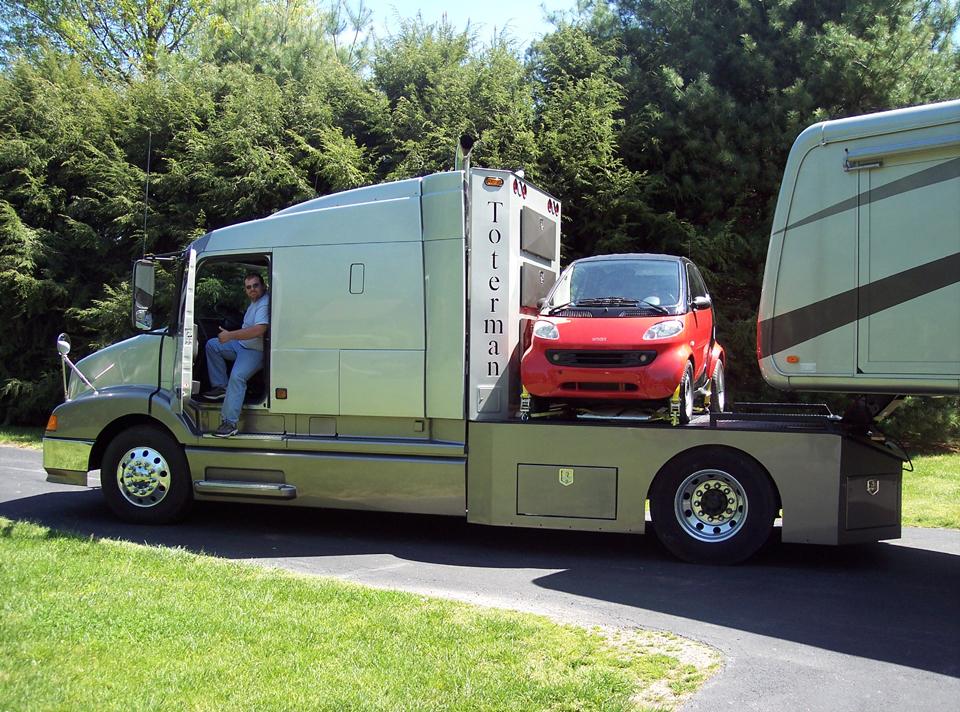 The main legal issue
involved with towing doubles is the combined length of the three pieces.
Most states allowing double towing have length restrictions on the total
length. Some have length restrictions on individual pieces. You need to
check the referenced links for particular state restrictions. But in
general, length restrictions are rarely enforced, and you can probably
tow through most states without any issue as long as they permit towing
doubles. Especially if you stick to
interstates and the national network. We have only heard of one person being cited for over
length. If you are stopped, you are usually told to separate the car, so
you should be prepared to do so. Check the Blue Ox site at
The main legal issue
involved with towing doubles is the combined length of the three pieces.
Most states allowing double towing have length restrictions on the total
length. Some have length restrictions on individual pieces. You need to
check the referenced links for particular state restrictions. But in
general, length restrictions are rarely enforced, and you can probably
tow through most states without any issue as long as they permit towing
doubles. Especially if you stick to
interstates and the national network. We have only heard of one person being cited for over
length. If you are stopped, you are usually told to separate the car, so
you should be prepared to do so. Check the Blue Ox site at